

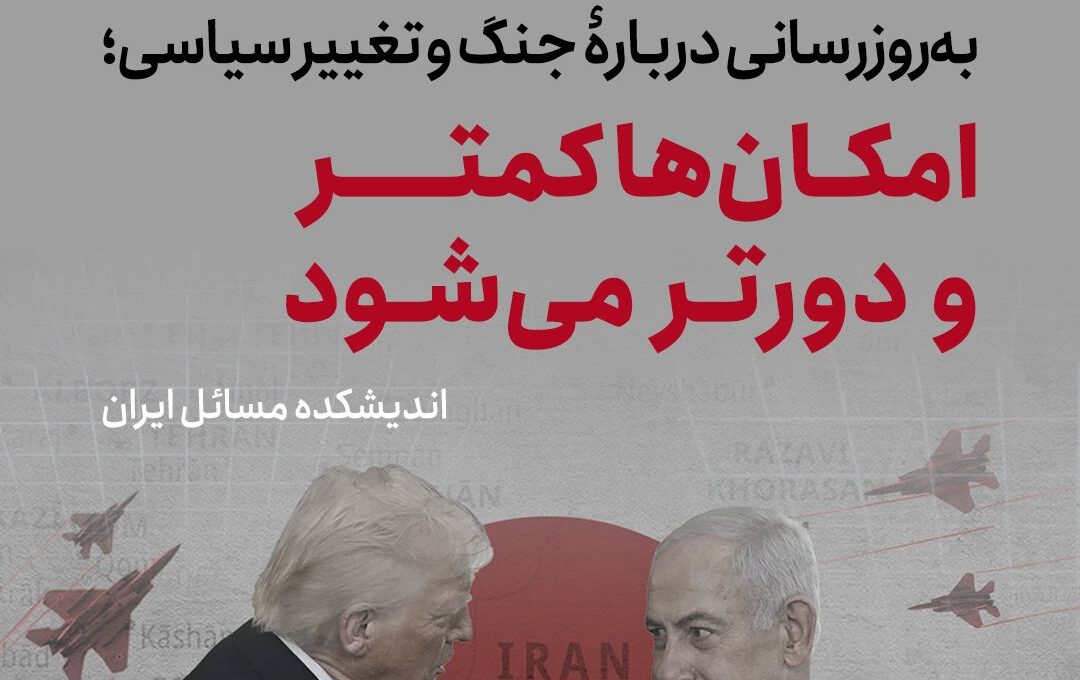
Over the past few years, the Think Tank of Iranian Affairs has published a series of analyses and forecasts about Iran and the Middle East. In this note, we consolidate and reassess our earlier views.
There remains a possibility that the war between Israel and the Islamic Republic will continue. That likelihood will be higher in October than in November; after November, the short- to medium-term probability of war will drop sharply. The window for political change through foreign military intervention will soon close. A second phase of war would expand the earlier set of military (especially missile) and nuclear targets to include political or infrastructure targets. War has drifted away from its previous forms and content, and technology has made it asymmetrical. In such wars, intelligence services sometimes account for 70–80 percent of the effort, with weapons playing only 20–30 percent. In this situation, an attack deep into the heart of Tehran (the governmental campus) could be one of the existing scenarios, with political targeting intended to produce political change. Countries with superior intelligence capabilities and advanced weaponry would create a one-sided, dominant front. In another scenario, on some pretext (or perhaps none), several targets might be selected among two gas (petrochemical) complexes and the ten main oil refineries; striking them could shut down Iran’s entire economy (fuel for vehicles, industry, and power plants). Such a disaster could cripple Iran for three to five years.
Shifts in the global and regional order remain the primary determinants of war and other developments in Iran. Changes within the Islamic Republic’s power structure and the role of the overthrow-minded opposition (including street protests) will continue to be minor. Israel is determined that change in Iran be fundamental. It knows it cannot land heavy blows on the Islamic Republic and then reach a sustainable state of security and development after a ceasefire (or even peace). Tehran will expend all its capacity to destroy or harm Israel. The lesson of October 7 has been profound. The “strategy of containment” in the Middle East has failed. After October 7, that illusion was shattered and a “strategy of change” began—rapid and forceful. In Syria there has been regime change; in Lebanon and Iraq, a change in behavior. The region has changed and will continue to change. No one thinks in terms of containment anymore. Israel now requires no elaborate justification to strike; it holds a war footing and military-technological superiority. Its long-term intelligence dominance will erode; thus it has an opportunity now.
Israel’s agreement to end military operations in Gaza is not outside the logic of the Western order and should not be reduced to a Trump initiative. Arab states accepted responsibilities and secured concessions for a role within the Western order; Israel’s government also yielded ground. Perhaps concessions will be given to it elsewhere (possibly Iran). With this agreement, Israel’s war of attrition has ended with the release of hostages; what remains is the question of security guarantees in Israel’s territory—apparently to be provided this time by Arab countries. Disparate jihadist forces in the region will be unable to remobilize behind the “Palestinian cause.” The problem remains the Islamic Republic and a few remaining allies (the Houthis/Ansar Allah in Yemen). Thus the Abraham Accords have been revived: the current Hebrew-Arab compact is directed against the Shiite and jihadist threat. The Brotherhood-aligned governments (Qatar and Turkey) will likely curb adventurism so that the only problem left is scattered jihadists and the Shiite fundamentalist government in Tehran. In such a situation, regional power arrangements in the Middle East will more easily take shape within U.S. multilateralism. Israel, as the region’s true power, can alongside the Saudi axis and even Turkey’s role provide assurances for the United States’ larger global plans. Nonetheless, for the United States the priority of anchoring states within the Western camp remains more important than Israel’s regional primacy (Israel’s military superiority is a long-term strategic view).
The Middle East has spent two years at war, and capital now needs greater certainty to move. A suspended, ambiguous situation serves none of the region’s key actors. Israel needs a real end to the war. Arab states must pursue their ambitious agendas with vigor. Other countries have serious problems of their own. Leaving the Israel–Islamic Republic confrontation unresolved is a major risk for everyone. The Yemen issue must also be settled; that would help address the remaining problems in Iraq, Syria, and Lebanon and support progress in the West Bank and Gaza. The suspended, ambiguous state will therefore not persist; the unfinished war between the Islamic Republic and Israel must be decided sooner. When there is no prospect for peace, there will be war. Peace would mean the Islamic Republic’s integration into a new, emerging order—something impossible under Khamenei and out of reach so long as the Islamic Republic survives in any form.
Containment and change (both behavioral change and regime change) must be examined more seriously. For some time, voices have resurfaced in defense of containment, arguing that containment’s failure on October 7 stemmed from misdefining its requirements and conditions. They say the same regarding the Islamic Republic: if the prerequisites of containment are correctly set, containing a war-weary, besieged Islamic Republic will be feasible. Hence debate over containment persists—especially among those who see containment as a precursor to change later. Where shifting the loyalties of the military is hard, only a period of debilitation can create conditions for change, as in Syria—or as in Venezuela today, where Maduro no longer enjoys his earlier position and supporters and officers are fatigued. For many, the preferred long-term scenario is attrition. But after serial failures of containment in the Middle East, can one still pursue containment and a drawn-out track like Venezuela—or a dilapidated, isolated Syria? Debilitation and bankruptcy can, at some moment, also set the stage for behavioral change, especially if that decision coincides with the looming succession. To render a revamped containment acceptable, actors sympathetic to reformists are advocating vigorously around the world.
With the 20-point agreement, the war in Gaza has ended. There may be several ceasefire violations yet, or Hamas may not cooperate fully. But it is clear regional states have decided the Palestinian issue must be resolved differently. Israel’s domestic issues will also be settled soon; the formation of a new government will proceed normally and Netanyahu will not face a dramatic challenge. The victory in Lebanon will be consolidated in this period. In Syria, a very slow process of stabilization and accommodation will advance. Iraq’s elections in a few months will reshape the scene there. Soon, outside the states themselves, no one in the Middle East will hold weapons. This decision will be pursued in Pakistan and Afghanistan as well. Therefore, a major decision must be made on Yemen, so that the Middle East’s problem set is confined to Iran. The trajectory concentrates ever more on Iran. But amid containment and change (behavioral change or regime change), decisions must be made quickly. Israel’s window for a military strike on the Islamic Republic will be short, expiring before others finalize their decisions. Israel knows it must act on its will before others decide, and thereby shape their decisions. Others know this too and are advancing ideas to restrain Israel.
After snapback, the Islamic Republic is in a position of weakness. Just as Grossi’s report in Khordad (May/June) marked the start of the first phase of war, snapback marks the start of the second. Eight months ago, the Islamic Republic could have reached an agreement with the West. What the West then asked for is now a wish list for Tehran. With every non-decision, the Islamic Republic has retreated several lines in its demands and bargaining space. After the June war and snapback, conditions are the worst yet for Tehran—even if it still hopes snapback will not be fully enforced and Russia and China will use all their leverage to preserve the prior legal status. Still, conditions will tighten. The world’s current state and the particularities of snapback implementation may keep Iran from experiencing sanctions as harsh as in 2012—or even 2019. Even so, the Islamic Republic is now living through its worst days.
Had the regional plan for a negotiated end to operations against Hamas not been activated, the second phase of war might have come earlier. From the “Days of Response” operations (October 1, 2024) to “Operation Dawn of the Lions” (June 13, 2025), the Europeans’ six-month pause (late 2024 to the June 2025 meeting) did not change Israel’s resolve. The Islamic Republic has fallen behind global technology. It lacks effective air and naval power, has weak air defenses, and its ground forces are geared to domestic repression and humiliated before global forces. Its missile and drone capabilities face many constraints. In the 12-day war, planning for multiple strikes to weaken Arrow and THAAD systems in preparation for two major salvos ultimately proved ineffective after a ceasefire; even had two large salvos been used at the outset, prospects were slim. In the next phase, with a projected war length of two to five days, Iran would have greater opportunity to use its missile forces—augmented not only by exo-atmospheric missiles but by swarms of cruise and hypersonic missiles and large numbers of loitering munitions. Even that will not balance the sides, especially given the intelligence gap. The Islamic Republic’s friends also have meager intelligence capacities in this region. China has yet to acquire the necessary global intelligence capabilities, and Russia has faced serious problems since its war with Europe in Ukraine. Hence a severe, short military action is likely.
Russia, China, and other regional and global actors require closer thought. Russia previously coordinated with Turkey and Iran to upgrade intelligence capacities in the Middle East—cooperation that helped the Islamic Republic assist Erdoğan in 2016. Until recently, the main external axis favoring Tehran was the Russian-Turkish one, with the Supreme Leader (Ali Khamenei) as its coordinator in Iran. On June 13 this year, it was even claimed that Turkey tried to warn Iranian military officials about Israel’s surprise operation. Overall, though, Turkey plays multiple games and may not repay its 2016 debt (just as Ilham Aliyev is ungrateful to the Islamic Republic for helping Heydar Aliyev in the first Karabakh war—and Tehran now backs Armenia). Russia, beyond its lag in intelligence, has not provided effective help elsewhere either: its air defenses do not work for Iran; and unlike Kazakhstan (January 2022), it cannot, if key cities fall, fly forces into a nearby international airport to organize troops and retake control by force. Russia is bogged down in Ukraine. If it can find a way out of that attritional war with Europe (in a deal with the U.S.), it might defend its last Middle Eastern ally. The fate of the war in Ukraine may weigh even more on the Islamic Republic’s survival or end than developments in the Middle East. Should Moscow end that war, Tehran gains a chance at survival. Qatar, the Brotherhood “brother” of Turkey, has sometimes cooperated in this Russian-Turkish axis, but now—with Gaza operations over—its role may fade.
China’s power and influence in Iran grow by the day. Beijing may have no desire to confront the United States anywhere before 2030, but it does not shy away from proxy and covert military competition. Even the Indo-Pakistani nuclear powers’ war was, in a sense, a proxy contest between Chinese and U.S. arms. Over the past year, China has been the largest source of military support to the Islamic Republic. Inside Iran, with the exception of Khamenei, all officials align with the China axis. Many military, political, and security figures favor joining China’s camp to resist the West. Reformists, former military officials, and some developmentalist moderates all want the Islamic Republic to “become Chinese.” China has crafted a complex Middle Eastern plan, creating a Chinese-Saudi axis to secure its interests and block the region’s Westernization. Since the Iran–Saudi accord in Beijing (March 2023), this has become more serious. Even Pakistan’s and Egypt’s limited support over the past month should be understood within this axis. China’s progress remains limited; hence its ability to help Tehran is constrained. But it hopes part of Iran’s elite can survive the immediate threat and soon align the country with China. Beijing believes that if the next generation of the Islamic Republic’s leaders do not go West, they will choose only China. In any case, a regime that for years sought to develop proxies to fight the West has itself become a proxy of China and Russia against the West.
The United States recognizes Turkey’s, Qatar’s, and Saudi Arabia’s partial misalignment with some of its programs in the region. In recent months it has pushed hard to change Turkish and Qatari behavior. Steps are also planned with Saudi Arabia (and Pakistan and Egypt). Turkey is to receive more U.S. weapons and be integrated into a new Middle East policy. Pakistan will also receive more arms; the U.S. will adjust ties with India and recalibrate Pakistan’s role in Afghanistan to keep Islamabad from drifting away. Qatar has a special security pact with the U.S. Saudi Arabia may soon sign a similar agreement. Serious steps are thus underway to keep the Middle East in the Western camp. All this heightens the urgency of resolving the Islamic Republic question. Israeli dissatisfaction may grow in the meantime: Israel was to be the region’s paramount power. Perhaps “Iran concessions” will be offered to Israel to create a new balance; perhaps peace with Arabs and the consolidation of certain territories will suffice, with Palestine becoming a collection of scattered cantons and Israel content with that. Forecasting has become harder, especially since outcomes are a function of the Ukraine war, China’s moves in the Middle East, and progress of the Abraham Accords. Iraq’s importance—especially after opening its new mega-port and in view of the future of its political (and military) order—will also be decisive.
Trump’s impact remains important. His “deliverables crisis” has been resolved; he no longer faces the problems of several months ago. His involvement in regional disputes and crafting various agreements give him breathing room. In the Middle East, he must now focus on keeping countries in the Western/U.S. camp. Security pacts and the Abraham Accords must be consolidated once all major threats end. Hence the Islamic Republic remains central; Trump cannot declare “Midnight Hammer” operations as the end of the matter. He can now better expose the failures of Obama-Biden policies in the region and has personal incentives to do so. Biden distanced Saudi Arabia from the U.S. and opened the door wider to China in the region; he erred on Pakistan and Afghanistan. Obama was a major calamity for the Middle East. Trump is closer to success in South America and the Middle East, and victories there would better position him to shape a new order in Asia and Europe. Energy market pressures will not weigh heavily on him for the next few weeks. Progress in Venezuela will give him more latitude. He may not see a settlement with Russia as distant and thus not worry about global energy supply. In any case, conditions in the U.S. are now favorable.
It still appears that a second phase of Israel’s (and the United States’) war against the Islamic Republic is likely: a short war which, if there is an alternative to govern Iran, could include a political phase with rapid developments. If the Western choice (led by the U.S. and Israel) is not the “policy of change”—specifically regime change—then strikes on infrastructure become likely. That would still begin with military and nuclear targets and then conclude with strikes on several major gas and oil complexes. This scenario would greatly alarm Arab states, since Tehran would then use all its capacities to disrupt regional gas and oil resources and energy trade. Domestically, there would be acute crises: fuel shortages for vehicles and buildings; fuel shortages for production; widespread blackouts (for lack of fuel); and disruptions to essential and welfare services. The regime would immediately securitize the environment, impose shutdown and quarantine rules like the peak of COVID, and pursue a national mobilization for war/defense. Abroad, it would use half of its missile and drone capacity, all of its proxies, and move ground forces to sensitive border areas. It would also resort to terrorism and asymmetric threats worldwide through a new generation of “lone wolves” and multi-cell gangs, as well as migration pressure. The region would descend into a dangerous cold war.
The Islamic Republic’s weakness in the June war (“Dawn of the Lions”) encourages this scenario—particularly amid rampant disinformation by think tanks, political actors, and officialdom that has muddied decision-making. Many reports and documentaries over recent months were crafted and spread to deceive. Decision-makers in Tehran, and many external advisers domestic and foreign, lack accurate assessments. Israel’s security penetration has declined and some military capacity has been restored, yet perceptions of Iran’s missile capabilities, plans, and actions remain manipulated. Iran has long been a “problem,” drawing intense regional and global intelligence attention: the U.S., Israel, Europeans (including the U.K., Germany, France), Russia, China, Turkey, Saudi Arabia, the UAE, Qatar, Pakistan, Azerbaijan, India, and others all run their own (or joint) programs—with emergency action plans.
A military strike need not be a surprise. The Islamic Republic no longer needs surprise. Actions may begin with more complex operations and sabotage inside the country, followed by military strikes. The main reason to choose infrastructure targets would be the absence of a viable alternative for transferring power from the Islamic Republic. If a transfer of power to moderates—or a transfer after regime change—were possible, this infrastructure-strike scenario would not occur. In that case, expanding the target set from military and nuclear assets to political figures and sites would be chosen instead.
In such a scenario, the goal would be behavioral change by the regime—or regime change. Unlike the June strikes, which did not enter an overthrow phase, this time the probability of an overthrow scenario is high. The model would resemble Yugoslavia (Milošević era) or Qaddafi’s Libya, with technological advances changing the details. Control of the skies by external forces would severely limit military maneuver from garrisons to political centers. In these conditions, symbolic strikes on political centers (especially targeting the regime’s political leadership) accompanied by parallel messaging to protesters to gather in city centers (or move toward the palace/government core) could produce a foreign-managed revolution. In this scenario, a special program to shift military loyalties becomes central to decision-making. If prospects for shifting loyalties are high, this scenario will be chosen. Militarily, the key is troop movement in Tehran. If smart strikes limit effective action to a few thousand troops inside the governmental campus, combined missile–fighter–drone attacks with a few hundred professional combatants could seize the political command and hold it easily for up to 24 hours. If, in that window, mass public presence, changes in military loyalties, and a forceful declaration of the end of the old order occur, the issue will be settled—akin to the fall of Baghdad without a ground advance from the border to the Green Zone: forces go straight to the heart of Tehran. The closer analogy, however, is Japan’s surrender—except the leadership here would never surrender; it would be killed or flee, enabling a transfer of power. The challenge is assessing troop movements, command capacity, and decision-making after the initial blows. The regime has adjusted command and succession structures to preserve decision-making capacity for core and surrounding forces under any conditions. Still, strikes always disrupt decisions.
Strikes could, beyond eliminating the supreme leader and leaders at every level, also target successors and successors-in-waiting—heightening decision paralysis. After the Leader, the Supreme National Security Council makes decisions. Formal reconstruction runs through the Assembly of Experts—which would not convene in wartime. The second ranking political official is currently the head of the judiciary. Other powerful decision-makers are known. Overt and covert military figures are known; so too the roles of Sarallah (the IRGC’s Tehran base) and Khatam headquarters. If regime change is the objective, the path is clear and domestic political actors will have no share. If, however, the difference between behavioral change and regime change is not large, a scenario of targeted eliminations and air control could test behavioral change while keeping open a regime-change path via the mass presence of people under a national alternative. The focus would be on limited control of military forces and removing one layer of political figures. In this case, war would last no more than two days. In an infrastructure-strike scenario, it would not last more than five.
The presence of a national alternative (Prince Reza Pahlavi) capable of governing (in an emergency) and facilitating power transfer and the military’s change of loyalty smooths the choice of scenarios for transferring power and regime change. Whenever decision-making is impossible, surrender becomes necessary: without the ability to decide, the military will quickly surrender to a national order. If the groundwork exists, this will be faster. Scenarios of using armed forces at the borders and advancing to the capital are meaningless under current conditions. Creating a safe zone far from the capital would ultimately mean eliminating all forces there. Given an unstable Syria, a fragile regional environment, and Iran’s western and eastern neighbors being hard to control, there will be no chance to create an Idlib (or Benghazi). Any prolonged scenario in this region is dangerous and undesirable. In a “capture/liberate Tehran” scenario, political actors will swiftly become the emergency bureaucracy rather than repressive decision-makers. From that point on, clarity about the model of change and a manageable, controlled transfer of power will determine outcomes.
A year ago, in “Will a National Revolution Occur?—On the Importance of Models of Change,” the Think Tank of Iranian Affairs outlined six possible models of political change in Iran: (1) velvet-style revolutions (Philippines, Eastern Europe, etc.); (2) a struggle-and-dialogue revolution (South Africa, etc.); (3) a negotiated/dialogic revolution returning to a prior or consensual order (Spain, Argentina, South Korea, etc.); (4) a revolution supported by limited, targeted foreign intervention (Yugoslavia, etc.); (5) overthrow via direct foreign intervention (Japan, Iraq, Afghanistan, etc.); and (6) collapse (the Soviet Union, etc.). In “The Challenges of the Model of Change,” we raised key questions about political change in Iran and have assessed and concluded across many notes since. Given current developments, models 1, 2, and 3 should be set aside. Model 2 remains the preference of social forces and transitionists; model 3 appeals to those seeking a return to constitutional monarchy. Previously, models 4 and 6 had higher priority and remain possible. But model 5—earlier considered less likely—has, in light of the past year and the heavy use of technology in recent wars, joined the higher-probability options, including the envisioned possibility of a smart war in the heart of Tehran.
The model of change is not merely an assessment of Iran’s political futures; it is a way to shape the role of domestic change actors toward other opponents and proponents of change. We can see which ideas and narrative shifts can help select the policy of change and discard containment in the Middle East. We can diagnose how to remove obstacles to choosing regime change—obstacles tied to forming a broad, powerful alternative aligned with the dominant discourse. Concepts such as national discourse, national leader, leadership organization, capacity to govern, change of loyalties, seizing the streets and mass mobilization, national solidarity and a big tent, the key question of political representation and legitimacy, acceptance of foreign involvement, advisory/assistance missions, the “Cyrus Pact,” crisis manageability, methods of struggle, and more are part of this influence-building.
Scenarios for Change in Iran
A) Transition from Stalin—A form of Model 6 without an actual collapse
Political change in Iran is no longer about the regime’s vulnerability; it is highly vulnerable and brittle. Yet changing military loyalties and transferring full power remain unresolved. Anyone can be eliminated under current hostile conditions; the present balance rests on Khamenei’s survival (and the regime’s “Russian” line). It is unclear whether an internal transfer of power (removing Khamenei and elevating a “Chinese” line) would end the regime’s hostility toward the region and the West. The “Russian line” has ended. The regime’s choice set is bounded by accepting a collapse narrative—that is, accepting a line of change within the regime. Today’s conditions resemble the Soviet transition after Stalin: a small group of powerful figures enables collective leadership for a revisionist period; some are then purged; finally one man prevails. At the first opportunity, policies of the prior era are jettisoned, ostensibly to return to the regime’s “original” period. But, as with Khrushchev, this does not last; Brezhnev (Stalin in another face) returns to the old line after a brief collective interregnum, delaying deeper opening. Some imagine that, right after “Stalin,” a Gorbachev could emerge and lay the groundwork for an eclectic nationalism fused with the prior system (here, Shiite nationalism). In this scenario, foreign policy shifts would follow Khamenei’s removal and the curbing of the Russian line. In Iran’s political structure, after Khamenei there is in fact no chance for the Russian line. Claims about a Russo-Turkish role in installing Pezeshkian and engineering the 1403 election cannot secure the Russian line’s survival. Russia will merely seek a meaningful share of benefits and some priorities. For this reason, Moscow prefers suspension in Iran; any change hurts it. Others argue that accepting behavioral change under Trump (and after the post-October-7 shocks) could be a Khrushchev-style transition that permits a Brezhnevist return later. This would accommodate the conservative preferences of regional states (all but Israel) and require no drastic action. Russia and others would need to persuade Israel and facilitate Khamenei’s removal.
B) Transition from Mao—A form of Model 6 without an actual collapse
This model also rests on a collapse narrative without a real collapse. Transition from Mao—leaving aside the first two years—means Deng Xiaoping’s “national socialism”: initial realism in foreign policy and internal control, later continued in various forms by Jiang Zemin and Hu Jintao, culminating in Xi Jinping’s different era. Here, behavioral change occurs through direct engagement with outside powers driven by incentives to integrate into the global order, ending the era of hostility. Even enmity with Israel could subside, producing stable behavioral change. Participation in certain regional pacts could guarantee it. Domestically, a form of nationalism (perhaps initially a Shiite, constitutionalist nationalism) would be adopted; fitting the Chinese model, one might call it “Iranian Islamism.” This model also requires Khamenei’s removal and the adoption of China’s line. Its agents in Iran are numerous and have been vocal in recent months. The problem is that, with the U.S. viewing China as its long-term adversary, such a scenario could be framed as “behavioral change while shelving the core enmities.” Regional mediation—especially by Saudi Arabia—may partly address this. Limited war in a second phase is not excluded here, particularly strikes on political targets; but immediate ceasefire terms and regional intervention to halt clashes—and even investment guarantees as a sort of compensation or inducement for behavioral change—are plausible. In these versions, political actors outweigh the military; economic power eclipses military power. The change unfolds in the political sphere, with the military as political agents. Iran’s initial groundwork arises from a pro-China policy; the end-state is détente with the West and integration into the Islamic countries’ regional order.
C) Japan’s Surrender or Baghdad’s Fall—Aligned with Model 5
This model is viable only because of today’s overwhelming technological (military and intelligence) superiority. Military action for surrender or occupation would not entail seizing the entire country; capturing the political and military command would suffice to transfer power and install an acceptable client government. Israel’s agency—under current conditions—would be decisive. Israel, for many reasons, is the only state that sees regime change in Iran as the sole desirable option. Iran’s social structure, distinct from most Muslim societies; lack of a land border; long-standing enmity with the Islamic Republic; Tehran’s role in arming anti-Israeli groups and fueling global anti-Zionism; the region’s current state; and the October 7 experience persuade Israel to “empty Iran of an Islamist state.” Its military-intelligence superiority makes a direct change in Tehran possible if global alignment—especially with the U.S.—materializes. Post-transfer concerns have been weighed in view of Iran’s military structure, bureaucracy, and conservative Iranian nationalism. Over the past three years, ties have been forged with the Pahlavi-aligned national movement. The June 2025 direct action has reduced these capacities—and may reduce them further in the long term. Given that no totalitarian regime in the world has fallen without foreign military intervention, Israel’s other options are riskier. In the modern era, genuine popular revolutions are exceptions; where such outcomes are claimed, the internal forces of change or the role of the military is being papered over. Given the Islamic Republic’s totalitarian structure, a popular revolution is unlikely. With broad sabotage capacities inside Iran, intelligence leverage, and security backing, Israel—partnered with the main transition force—could effect direct regime change with a 24-hour surprise strike on central Tehran. Missiles and especially fighters would change the field in phase one; limited special forces, supported by drones, could overcome the VIP protection units. Fighters and other measures would prevent other formations from joining. Preventing armed disorder elsewhere and blocking harmful interventions by neighbors is manageable in this model, and Russia (and China) can be kept out.
D) The Fall of Milošević or Ceaușescu—An update to Model 4
In the national alternative’s preferred Iranian scenario, once the first significant mass protests emerge, Israel—on behalf of the Western order and with strong U.S. support—would back the protesters: establishing an “air shield,” striking repression organs, imposing military neutrality (keeping units in garrisons), and providing meaningful drone support to protesters along with intelligence measures to influence media and communications and create effective urban disruptions. This could come after a period of quasi-war and widespread belief in the regime’s collapse, followed by attacks on the presidential palace and some garrisons, then mass marches on the palace (here, the governmental campus including the Leader’s Office and Pasteur). Or initial scattered protests could be followed by overt military support and then a nationwide call by a national leader (Prince Reza Pahlavi). A version akin to Romania—external support without direct intervention, using intelligence tools to enable mass action and ensure military neutrality—is also possible. Drawing on Syria’s experience and what is now unfolding in Venezuela (after two decades of instability and crisis), a drawn-out variant could be pursued: initial military blows, then deepening crises, internal collapse of morale, erosion of supporters and officers, culminating in changed loyalties and a managed transfer of power. Since war is the main trigger for nationwide protests in Iran, a “popular revolution” is only plausible under war or semi-war conditions. While some argue that people avoid the streets during war, distinguishing war conditions from broad urban bombardment keeps this idea on the table. A “national revolution” in Iran depends on military loyalty shifts, the return of the street, and a political leadership of protest. Based on these three, all other revolutionary or negotiated power-transfer paths under a totalitarian order are set aside; the available models narrow to those above, with the window for change either short-term or postponed for years while neighbors normalize and Iran declines and debilitates.
E) Other possibilities can be imagined, but given Iran’s military structure, the nature of moderates and revisionists, and barriers to large nationwide protests, they should—for now—be excluded. A classic military coup like Turkey, Pakistan, or Egypt is unlikely today. Post-Soviet-style popular revolutions in Eastern Europe find no analogue here. A Philippines-style negotiated transition is inapposite. Any intra-regime change would resemble the Soviet or Chinese patterns; the rest should be set aside.
Do the Street and Street Politics Have a Chance?
The “street” in Iran is complex and deceptive. For years, our picture of it has been distorted. Faux concepts such as “resistance in the street”—more stealthy non-struggle than struggle—have muddled understanding. For two decades, reformists and parts of civil society were allowed to express views and symbolic actions in the “licensed” domain; what the regime tolerated warped the concept of street action. The last truly large political gatherings were in 2009, but they were aimless and ineffective; February 2011 (Bahman 1389) was premature. A crisis of meaning prevented even symbolic gatherings until February 2017. Then, December 2017 brought major confusion: the “licensed” arena gave rise to medium, “unlicensed” protests. Sporadic gatherings followed (notably August 2018) around livelihoods and local demands. The fuel price hike of November 2019 produced an explosion of the public’s desperate anger—the broadest and most intense protests of recent years. But without leadership and a political program—and under severe repression and a near-total internet blackout—things ended after five days. The November protests were extensive and intense, but no single rally of tens of thousands coalesced. Thereafter, scattered protests continued. After Mahsa Amini’s death in September 2022, perhaps twice we saw rallies with tens of thousands; overall the protests were widespread and persistent in parts, yet lacked an overthrow dynamic. Tight regime control, arrests/detentions of key activists, the folly of some exiled political actors, and two major misframings—ethnic and gender—brought them to an early end; the subsequent repertoire of symbolic actions also failed.
The great lesson of 2022 is that without an agent of change (an effective political force) and without real international backing, the street goes nowhere. Over the years, the licensed opposition (from reformist campus/media/party activism to pensioners’ and guild protests) and some showy, self-centered opposition celebrities have consumed the street. Whenever the street has been produced—and the idea of being in the street has matured into seizing the street—these actors have mounted it and hollowed it out. For the mass of Iranians, change is a survival necessity; for social-movement “activists,” it’s a pastime of elites. The diaspora misreads developments and is always late to grasp the presence or absence of issues inside Iran. When nothing is happening, it imagines daily resistance and struggle. For them, “struggle” resembles symbolic activism in democracies and is mismatched to a totalitarian, highly repressive state. The consumption of the street and concept manipulation have made street work harder: endless talk of symbolic campaigns, the hollow myth of a nationwide strike, nightly slogans, and calendared anniversaries and “color” ideas—while few grasp real, effective struggle. Campaigns succeed in optics while the street is consumed; licensed dissent continues. On the other side, some write of the importance of “taking Tehran,” seizing the street, and a Day of Sacrifice, knowing there is only one chance: a massive political crowd in the capital aiming to seize meaningful power. It will be a single moment—if it comes.
Thus the “street idea” finally becomes a question: how to produce a massive political crowd. In various notes, the Think Tank of Iranian Affairs has identified three components: Great Anger, Great Organization, and Great Disruption. In current conditions, Great Anger and Great Organization can only amplify; they cannot trigger. Great Disruption, while not a complete idea, can be a trigger. Triggers span political (succession, war, political assassination, a call), social (hijab, internet, right to life, etc.), economic (gasoline, diesel, energy/water crises, inflation and shortages), and more. Given the social tolerance logic and the manageability of certain crises, only in specific conditions would gasoline/diesel price hikes trigger protests; political assassination and calls could; but more likely war and succession would trigger change-producing protests. Such protests must quickly become political and be coupled with Great Anger and (relative) Organization. They will succeed if they are built on Great Disruption and professional militants. Disruption can target, simultaneously, bank cards, fuel cards, traffic lights, public transport (metro, ride-hailing, BRT), specific power and telecom nodes, etc., and it must rely on data about where and when to gather (see our note “Are Nationwide Protests Possible?”).
Is There an Alternative to the Islamic Republic?
Many political and non-political actors have claimed change (reformist or revolutionary). Most lack a model. The reformists’ failure—beyond misreading totalitarianism—stems from not having a model of reform: they did not know what and how to reform. Ideas existed in brief spurts: social pressure while in power, internal trust-building and external détente, normalization, economic development, and entry into a global welfare order—vague and general. Reform, in short, came without a model—and lately reduced to remaining in office for the succession. Overthrowists clung to velvet revolution as an idea but lacked a field where that model fit (the Green Movement). Leftist revolutionary ideas were doomed from the outset. “Call-driven” (non-movement) approaches became stages for display. Organized armed struggle backed from abroad—pursued by the MEK and some ethnic groups—was also bound to fail.
Given the unique features of political change in each country, a different idea has taken shape in recent years: a “national revolution” with some chance of success—exploiting fractures within power and defecting regime forces (especially the military), combined with the return of the street through “uprising-to-seizure,” under global alignment (maximum pressure and maximum support). Limited organization has been pursued for years. National solidarity—through a “big tent” framework of national cooperation—has advanced; a leadership organization has been sketched through several program-driven bodies and plans for governance. A set of groups, lobbies, think tanks, and media has been defined to serve the leadership organization. On paper, all looks good—yet in practice, political inexperience and unlearned behavior create challenges. In earlier periods, parts of the opposition succeeded in parts of this: some had powerful political ideas; some had more effective lobbying or more coherent cores—but luck failed them. Under current conditions, only the national discourse and national revolution under Prince Reza Pahlavi have a chance. Given Iran’s social shifts, the national discourse (not the entirety of ’79) and Western-orientation (modernism) have long been established, and the national leadership (Prince Reza Pahlavi) has stabilized his role. Rivals, however, for various motives refuse to accept that this is the time of a national revolution led by Prince Reza Pahlavi (and that others cannot now succeed). Their aim is to block opposition alignment now, hoping to alter the opposition’s discourse, leadership, organization, or model later.
A serious problem in Iran is political representation (see our article “The Crisis of Political Representation in Iran”). In a manipulated environment, representation is blurred. Party activity and formal organization are impossible; a handful can gather and claim to be a political current. Anyone can form a circle and call it a party (though it is not). A person with a single symbolic action or a passing surge in social media can demand attention and recognition by political and media actors; every woman with a first act claims to represent Iranian women; every victim claims to represent justice; every writer or graduate claims to represent intellectuals; every patriot claims to represent nationalism; every activist or prisoner claims to represent the struggle. But whence comes this representation? Are these people truly trusted (legitimate) and credible (real) within their claimed group and, ultimately, in Iran? (Our notes on representation cite many examples.)
Identifying a few main intellectual and political currents, classifying and “labeling” by political actors, polarization around core issues, social media debate, and pressure on media may help in a pre-political environment (without safe, formal activity). First, set aside non-political criteria; then, on the spectrum of right (conservative/liberal) and left (socialist/communist), locate people. Next, use dominant, rival, or problematic discourses—nationalism, political Islam, Western-orientation (modernism), and forms of cultural Marxism—to label and recognize. In the end, a person should not say, “I represent Iran because I have struggled,” but rather, “I represent conservative nationalists” or “revolutionary Marxists,” etc. This clarifies even social representations (anti-compulsory hijab, media freedom, freedom of belief, etc.). Serious debates over individualism, socialism, various freedoms, distributionism, and redressing historical discrimination (affirmative measures) can move from sloppy claims to measured criteria within like-minded groups. Political representation, in today’s chaos, can thus be shielded from grandstanding personalities (even those with histrionic disorders), from harmful adventurism by those without records, and from security games by repressive organs. Representation will remain challenging; yet by focusing on polarized issues and long-term public desires—nationalism, individual freedoms, opposition to the entirety of ’79 (from political Islam to Marxist left), the desire for normal life, a modern state, and modernism—we can evaluate credibility and legitimacy.
In the end, not everyone can be allied in Iran’s political change. Some support the Islamic Republic; others, for their beliefs, oppose any new revolution. Under a dominant discourse hostile to the entirety of ’79, those who support—or took part in—the 1979 revolution cannot align with today’s dominant overthrowists. Anyone devoted to political Islam is outside national solidarity; so too anyone devoted to Marxist leftism. The left in Iran has no defensible record; they can only claim a share in 1979. They have done nothing else of consequence (save terrorism and sabotage under the Pahlavis and support for 1980s economic policies). Any current at odds with the entirety of ’79 is thus at odds with the left’s record and cannot cooperate with it; the left, defined today against nationalism, cannot be part of the dominant discourse and ends up aligned with political Islam and regime supporters—outwardly closer to extra-government reformists, but in practice serving power brokers to outlast nationalist dominance. Among non-left, non-’79 believers, some—due to ego, jockeying, or conflicts with those enjoying current favor—cannot ally with change. These must be managed individually to avoid needless harm. They often exacerbate the representation problem. Here, debates must be grounded in track records, not claims, to enable the “big tent” of national solidarity to advance joint action under the national revolution’s leadership organization. Some criticisms are valid, but others simply seek personnel changes atop the leadership organization and complicate matters. The more substantive critiques are theoretical—above all, about the model of change and victory program.
Will Loyalties and Beliefs Change?
Repeated failures have made Iranians conservative in political action. They have often taken to the streets without meaningful progress. They have learned hard lessons and gained realism about change. But the logic of failure produces abstention: an inability to repeat past actions. Society will not easily mobilize for a great protest (and a massive crowd will not form). Defection and quitting in a state-dominated economy are hard; for the military, harder still. With decades of double-digit inflation and recent 40 percent inflation, circumstances worsen.
In daily conversation, including among state employees and military personnel, one hears open opposition to the Islamic Republic and the desire to move on. But voicing dissent and taking concrete action are rare—though at the right moment for protest or at the final moment for expressing anger and opposition, people will not abstain. Some might again trust intra-regime change and reformists, especially if the national discourse of overthrow fails—but there is no sign of that yet. Today, Iranians will watch for two things: have the regime’s friends and enemies changed? and can severe repression—especially military action against the people—be prevented?
Thus, alongside global/regional shifts and opposition dynamics, changes in military loyalty are crucial. These may manifest as neutrality or a refusal to kill. Even limited signs of willingness to surrender will be sensed in ordinary and family communications. People will understand whether there is a global will to prevent repression (with serious warnings and readiness to strike the repressors) and whether the opposition’s calls for presence to transfer power (or protect it) are serious. Under current conditions, absent direct coercive force, loyalty shifts are unlikely. Hence the street has no meaning without structural changes in repression. Even with restraints on repression, surprise and initiative are needed. Loyalty shifts are likelier in the form of surrender—prompted by command disruption through decapitation or severed communications, limited mobility and enforced garrisoning, and, above all, engineered indecision. When decisions cannot be made, every force drifts toward surrender.
Within the military, there is a tendency to hand over power—provided participation in power is ensured. This tendency is far stronger in the bureaucracy. Even at the level of deputy ministers and governors, many say it doesn’t matter to them who governs; some prefer a change and constantly decry the current structure’s incapacity. If transition terms offer them roles and incentives, loyalty shifts and power transfer will be facilitated.
**
Narratives and ideas are powerful. Whoever can impose concepts and ideas under these conditions can obtain their aims (or some of them). Narrative-building, forecasting, and perhaps planning require cognitive power—what is also called “cognitive warfare.” In an environment of hidden and manipulated data, political forces face a hard task. But discourses and concepts flow from past efforts and events that were real and consequential; these can be used to build the future. Everyone with ideas for change must present them seriously. Social media, in these conditions, will rival Iranian and international think tanks in importance.
Threshold and unstable periods must be grasped through Carl Schmitt’s “state of exception”: a pre-political condition in which only political confrontation makes sense, and economic, social, or legal interpretations become problematic. Everything is understood through friend and enemy (a binary), and only dominant wills operate; no rules or norms exist—only “decision.” Whoever can decide determines all; others surrender and follow. Those who cannot exclude war as an option; commanders who cannot issue orders to act; political forces that do not declare support or opposition—will be sidelined. In tomorrow’s Iran, grasping the state of exception is decisive. The refusal to decide means the necessity to surrender. As indecision grows by the day, surrender becomes the key analytic concept. One must decide and seize the last opportunities for change. Opportunities are becoming fewer and being pushed further away. There is no ideal option for today, but acceptable choices still exist. With decision, one can still remain in this game.
What Will Happen in the End?
Probably within a month, to block one of the Islamic Republic’s missile or nuclear programs, Israel will conduct an operation and then humiliate Tehran severely. At that moment, the regime’s decision will determine how friends and foes move to end this long saga. Now—or then—the regime can choose scenarios A or B and change course itself. But it is unlikely to decide (or have time to). If it responds militarily (which itself signals indecision), Israel will strike military command and political leaders, prioritizing Khamenei. From that point, the real capacity and decision-making of the Islamic Republic’s opponents (probably Prince Reza Pahlavi) will be decisive; otherwise, escalation in the skies and lethal exchanges will carry matters to strikes on gas and oil complexes—pushing political change farther away than it should be. Soon, options and choices will narrow for everyone. Whoever does not decide in time will be condemned to removal or surrender.
In preparing this note, we drew upon forty prior notes and articles by the Think Tank of Iranian Affairs.